Pages

Thursday, October 11, 2012

From Cradle to Grave - William T. Burnett

William T. Burnett was my second-great grandfather on my father's side. He was born January 16, 1861 in Kingsville, Missouri to Thomas Jefferson Burnett and Harriet Potts. I don't know much about William other than his appearance on various census documents.
William is found on the 1870 census in Cass County, Missouri with his parents and sisters.
In 1880 the family has moved to Kingsville in Johnson County, Missouri and William is listed as working on a farm, presumably his father's.

Now we lose William for twenty years, thanks to the loss of the 1890 census. We pick William up again in 1900.
He has been very busy! The 1900 census gives us a lot of information on William. He was married sometime around 1886 and has had four children: Iola, Audrey (my great-grandfather), Irene and Oliver. The family now lives at 2615 Harvard Avenue in Kansas City, Missouri. I can find no official record of his marriage to Mattie or Martha Landes in 1886.

In the 1910 census Martha Burnett is listed at 3020 Montgall Ave., Kansas City, Missouri.
William is noticeably missing. And Martha is listed as a widow. Sad. However, I know that William isn't dead because I already have his death certificate listing his death in 1932. Interesting.

In 1920 Martha is living with her daughter, Lola, and is listed as divorced. In 1930 she is again in Lola's household and listed as widowed. Make up your mind already! Is the kat dead or not? During these years I have not been able to find William with any concrete proof. I found one potential match but he is married with additional children, none of which are mentioned in his obituary.
William T. Burnett's obituary printed in The Kansas City Times April 28, 1932
His obituary lists Mattie as his widow. And, at the time of his death he is living with his brother, Marion. So what happened between 1900 and 1932?
William is buried in Kingsville Cemetery, Kingsville, Missouri, along with his parents. I have not found any information on a divorce between William and Martha. I'm not even sure where to look. They would have been living in Jackson County, Missouri, so I'll start there.

William's missing pieces:

- Where was he between 1900 and 1932?
- Divorce decree between William and Martha.

Wednesday, October 10, 2012

Wordless Wednesday - Girls having fun

My mom, on the left, having some fun with her mother and sister. I'm thinking this is mid-1970s.

Tuesday, October 9, 2012

Tuesday's Tip - From Cradle to Grave; finding the gaps in your research

I'm at a strange place with my genealogy research. I've reached pretty far back in time on all of my lines and have found fantastic things. However, I can't reach any further back with just my friend the Internet. I'll have to hit ground to learn more about each line. But that means a road trip out east...not going to happen right now.

So, I'm left to delve deeper into the more recent lines. Those that I can track down holes in my research utilizing the Internet or, gasp, snail mail. It feels like I've covered the ground on my great and great-great grandparents pretty thoroughly, but I'm sure there are gaps.  I have found that if I pick an ancestor and outline their life from birth to death in writing, I can easily pinpoint what I'm missing or, what I can add to better round out my research.

Minnie Lee White and Elizabeth Dudgeon
To that end I have decided to begin a new series on my blog entitled Cradle to Grave. I will choose an ancestor and follow my document trail of their life from birth to death. Through forcing myself to write this information I will find the documentary gaps I have for each ancestor and narrow my research focus. It may not be tantalizing reading, but it could help fellow researchers and it will definitely help me!

I'll post the first iteration in the series on October 11 focusing on William T. Burnett my dead, not dead again, second-great grandfather.

Saturday, October 6, 2012

A Message to Garcia: Roycrofters' pamphlet

A few days ago I wrote about the short story A Message to Garcia. Written in 1898 by Elbert Hubbard, it is a story highlighting the importance of self-motivation and loyalty among employees to the company or organization they support.

Nancy of My Ancestors and Me wrote and said she would like to see some scans of the pamphlet of the story as printed by Elbert Hubbard's company, The Roycrofters. I am happy to oblige below. These scans are from a 1917 version of the pamphlet from my personal collection.
Cover of a 1917 printing of A Message for Garcia.

Inside front cover.
The first page of the short story.
Inside back cover.
I love the design elements of this piece. I have always thoroughly enjoyed the design of the Arts and Crafts movement and this is a good example. For more information on Elbert Hubbard or The Roycrofters, visit the following links:

Elbert Hubbard, Roycroft and the Arts & Crafts Movement in America
The Roycroft Campus Corporation
The Roycroft Inn
The Roycrofters


Thursday, October 4, 2012

Can you date furniture?

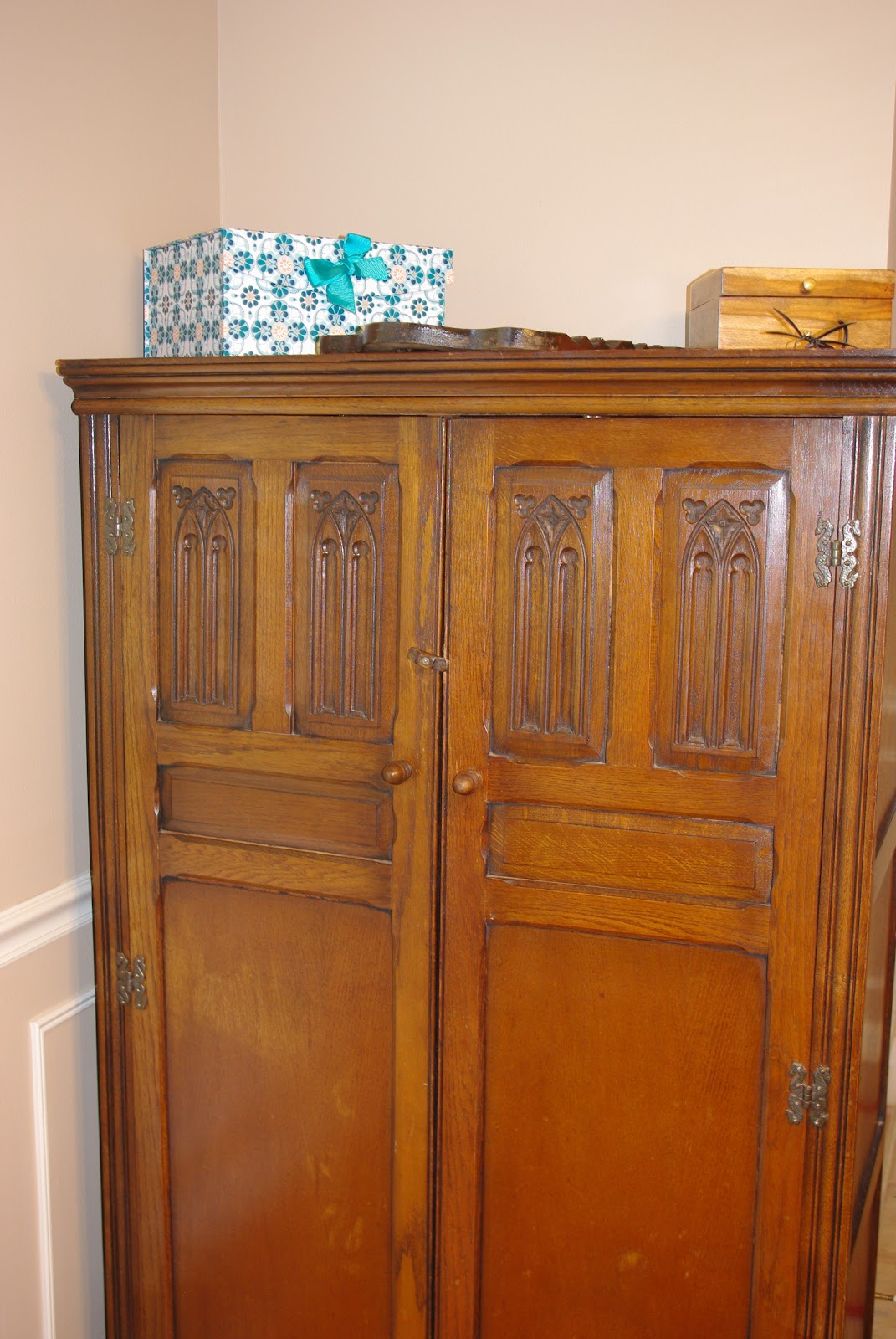
I love antique stores. I could walk through them for hours, but I'm "cheap" and hardly ever buy anything. A couple of weeks ago we were walking through our favorite local antique and collectible store and this armoire jumped out at me.
I instantly fell in love with it. My husband, who is not cheap, was shocked when I said I wanted it. It was listed at $200 and we bought it for $170. I was instantly drawn to the carvings on the front.

This piece did not come with any information and there are no markings on it to indicate where or by whom it was made. It was clearly built as an armoire as you can see the bar for hanging clothes and the mirror mounted on the door.
The liners on the shelf are cut up place mats from Target (By the way, I am one short and my Target is sold out of these mats so if you find a red and white place mat at your Target let me know!). I plan to use this armoire to store my plethora of quilting kitsch and fabric.

I would love to know the approximate date of this piece. Can you date furniture?

Wednesday, October 3, 2012

Wordless Wednesday - Clifton White with car

Clifton White with vehicle and tape marks. Date unknown, but presumably early 30s.

Monday, October 1, 2012

Military Monday - A Message to Garcia

A Message to Garcia was never meant to be the inspirational piece that it has become. The author, Elbert Hubbard, penned the short story to fill an empty space in the March 1899 publication of his magazine, The Philistine. Before he knew it, he was receiving request after request for his short story to be printed in pamphlet form. Employers all over the world wanted their employees to read A Message to Garcia.

In the story, Hubbard tells the story of Lt. Andrew Rowan, who was chosen by President McKinley to carry a message to General Calixco y Inigues Garcia, leader of the rebel Cuban troops at war with Spain in 1898. Rowan was assigned to find General Garcia in the wilds of Cuba, announce the support of the U.S. and find appropriate points of debarkation for U.S. troops. All of this without being captured by Spanish troops.

A heroic event in and of itself. But the journey was not what Hubbard highlighted in his story. He chose instead to celebrate the "how" of Rowan's journey. Rowan did not ask the President how to find Garcia, where he was, how to carry the message, how to charter a boat. He just did it. Without questions, without complaint, without issue. This commitment to duty was his true legacy.
Colonel Andrew S. Summers
You'll find A Message to Garcia on many military reading lists and its story resonates even today. Lt. Rowan was promoted to Lieutenant Colonel for his bravery. He retired from the Army as a Colonel in 1909 and he died in 1943. Hubbard, the author, was a successful businessman and leader in the Arts and Crafts movement. He and his wife were killed aboard the Lusitania.

Read A Message to Garcia with a special preface by the author here. You can read Lt. Col. Rowan's version of the the story here.